
Prime Minister Narendra Modi addressed the Indonesian parliament, emphasising India's commitment to development over expansionism and advocating for a free, open, and inclusive Indo-Pacific. He highlighted the strong historical ties between India and Indonesia, calling for enhanced cooperation in various sectors, including defence, technology, and counter-terrorism, amidst growing concerns over regional security.

The Quad has come of age and its agenda covering areas like vaccines, climate change and emerging technologies makes it a force for global good, Prime Minister Narendra Modi said at the first summit of the coalition. In his opening remarks, he also talked about shared values and promoting a secure, stable and prosperous Indo-Pacific.
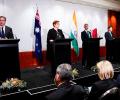
The foreign ministers of the Quad grouping of India, the US, Australia and Japan on Friday held extensive talks in Melbourne amid escalating tension between Russia and NATO countries over Ukraine, the Afghan crisis and increasing concerns over China's "coercion" in the Indo-Pacific region.

The economic fallout of the West Asia crisis, the prevailing security situation in the Indo-Pacific and ways to boost cooperation in critical minerals and technology are expected to top the agenda at a crucial meeting of the Quad foreign ministers on Tuesday.

Notwithstanding the economic complementarities and the host of agreements for deepening economic relation on a host of areas, both sides share common viewpoints on the foreign policy domain and seek common grounds to serve as a counterweight to China, notes Dr Rajaram Panda.

In a region increasingly shaped by competition and coercion, such collaboration strengthens security without confrontation, builds capacity without dependency and promotes order without domination, points out Dr Kumar.

Prime Minister Narendra Modi was accorded a grand welcome on his arrival in Jakarta on Monday, with Indonesian Air Force fighter jets escorting the PM's aircraft upon entering Indonesian airspace, marking a ceremonial welcome.

The Indian government informed Parliament that India and the US are engaged in negotiations for a mutually beneficial multi-sectoral bilateral trade agreement. The two countries also cooperate on strategic, economic, and defense matters, managing divergences through high-level dialogues.

External Affairs Minister S Jaishankar has affirmed India's commitment to ensuring issues like a free, open, and rule-based maritime order, seafarer safety, and countering terror financing receive due attention at the UN Security Council during its 2028-29 term.

India and the US have signed a framework agreement for defence cooperation for the next 10 years, enhancing their partnership and aiming for regional stability.
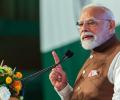
Prime Minister Narendra Modi on Friday said it is important for India and China to work together to bring stability to the world economic order as he asserted that New Delhi is ready to advance bilateral ties from a strategic and long-term perspective based on mutual respect, mutual interest and mutual sensitivity.

Four-nation grouping Quad on Tuesday launched a major new initiative for the Indo-Pacific that allows the partner countries to fully monitor the waters on their shores and help ensure peace and stability in the region, a move that comes amid China's increasingly intimidatory behaviour.

'We condemn recent illicit missile launches in the region that violate UN Security Council resolutions. We express serious concern over recent dangerous and aggressive actions in the maritime domain. We seek a region where no country dominates and no country is dominated one where all countries are free from coercion, and can exercise their agency to determine their futures,' the declaration said.

Singh emphasised that the Indo-Pacific is no more a maritime construct, but a full-fledged geo-strategic issue, and that the region is facing "a complex web" of security challenges, including boundary disputes and piracy.

The coast guards of India, Japan, the US and Australia have launched the first-ever "Quad-at-sea" mission to boost operational coordination and interoperability in the Indo-Pacific.
The meeting to be presided over by External Affairs Minister S Jaishankar will be attended by US Secretary of State Antony Blinken, Japanese Foreign Minister Yoshimasa Hayashi and Australia's Penny Wong.

European Commission President Ursula von der Leyen says India and the EU are close to a 'historic trade agreement' that could create a market of two billion people and account for almost a quarter of the global GDP.

Prime Minister Narendra Modi has met his Australian counterpart Scott Morrison in Washington, DC, ahead of the first in-person Quad meeting to be hosted by US President Joe Biden and discussed a broad range of issues of bilateral, regional and global importance, including the Indo-Pacific.

The latest announcement was made by the US Defence Secretary Jim Mattis during the change of guard ceremony at Joint Base Pearl Harbour wherein Admiral Phil Davidson replaced Admiral Harry Harris as Commander, US Indo-Pacific Command or IndoPacom.

Prime Minister Narendra Modi has said that the Quad is not against anyone, but for a rules-based international order and respect for sovereignty, in a veiled reference to China.
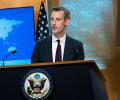
"India is a global strategic partner of ours. We have a wide, broad, deep relationship with India. There will be a lot on the agenda in the bilateral relationship and in the multilateral engagements he takes part in on the margins of the G20," Ned Price, State Department Spokesperson, told reporters at his daily news conference.
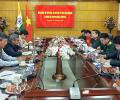
The 15th India-Vietnam Defence Dialogue signalled a move from routine talks to deeper cooperation, with new deals on submarine rescue and defence industry to support stability in the Indo-Pacific, notes Dr Rajaram Panda.

The leaders said they stand for adherence to international law, peaceful resolution of disputes and respect for principles of the UN Charter, including territorial integrity and sovereignty of all states.

PM Modi articulated five action points that would serve the common interest of promoting peace and prosperity in the Indo-Pacific region.
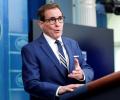
National Security Council Coordinator for Strategic Communications (NSCCSC) John Kirby on Tuesday told a press conference in Washington, DC: "India will be a critical strategic partner for the United States in the coming decades."

The Indian armed forces, especially the Navy, are building partnerships in the Indo-Pacific region for peace and security, as well as humanitarian assistance and disaster relief, he said.

India, Australia, Japan and the US on Friday pledged to work together for ensuring peace and prosperity of the Indo-Pacific and the world, as top leaders of the Quad grouping announced a slew of new initiatives to take on common challenges, amidst muscle flexing by an assertive China in the strategic region.

The leaders of the Quad comprising India, the United States, Australia and Japan are set to demonstrate that the grouping is a 'force for global good' and has a unifying commitment to a rules-based international order amid China's increasingly intimidatory behaviour.

'The President-elect firmly believes we can avoid conflict with the Chinese Communist party because they need our markets.'

Less than a month after the historic visit of Prime Minister Narendra Modi to the US, a Congressional senatorial Committee has passed a resolution recognising Arunachal Pradesh as an integral part of India.

White House Press Secretary Karine Jean-Pierre said the upcoming visit will affirm the deep and close partnership between the United States and India.
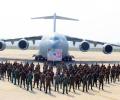
Dharma Guardian 2025 will primarily focus on urban warfare tactics and counter-terrorism operations and underscores the growing strategic partnership between India and Japan.

Prime Minister Narendra Modi on Friday held bilateral talks with Italian counterpart Giorgia Meloni in Bari during which they discussed defence and security cooperation and hoped for further enhancing the defence industrial collaboration.

In his opening remarks at a ministerial meeting in Tokyo of the Quadrilateral coalition, also known as 'Quad', External Affairs Minister S Jaishankar said India remained committed to a rules-based world order, respect for territorial integrity and sovereignty, and peaceful resolution of disputes.

Prime Minister Narendra Modi on Tuesday offered a floral tribute to former Japanese premier Shinzo Abe at his state funeral in Tokyo.
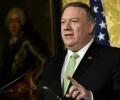
Pompeo would leave for New Delhi on June 24.
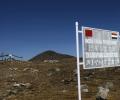
The resolution also pushes back against People's Republic of China (PRC) claims that Arunachal Pradesh is PRC territory, which is a part of the PRC's increasingly aggressive and expansionist policies.

Prime Minister Narendra Modi's visit to the United States this month will set new benchmarks for bilateral ties and some 'really big, historic and exciting' announcements are likely to be made on defence cooperation and boosting India's indigenous military industrial base, the Pentagon has said.
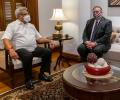
Pompeo, who became the Trump administration's highest ranking official to visit Sri Lanka, said that the US and Sri Lanka shared a vision for democracy to build a relationship and the "freedom to hold democratic elections".

Prime Minister Narendra Modi will participate in the first in-person summit of the Quad leaders in Washington on September 24 that is expected to broadly focus on contemporary global challenges including ways to ensure a free, open and inclusive Indo-Pacific.
